Balcony Fruiting Vegetables: A Crop-by-Crop Guide
Fruiting vegetables ask more of a balcony than salad leaves do: a longer growing period, strong light, a root volume that stays evenly moist, and often some form of support. The best choice is not simply the smallest plant on a seed packet.
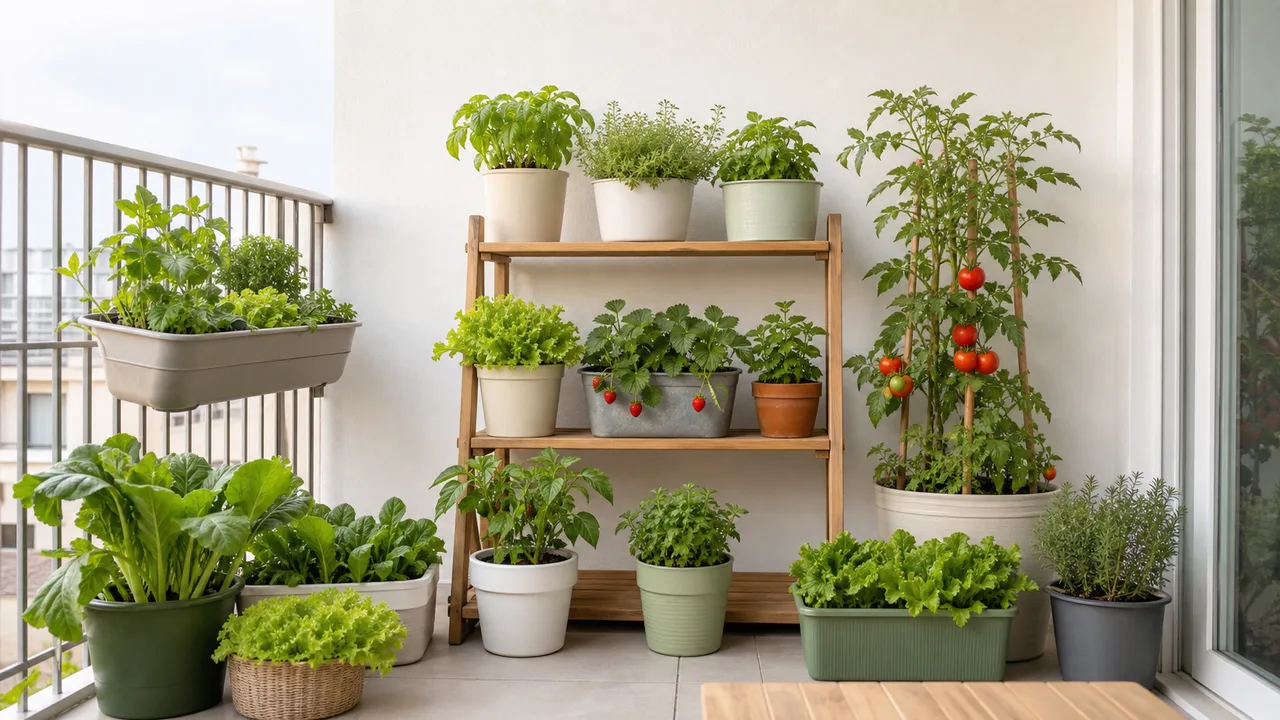
Fruiting vegetables ask more of a balcony than salad leaves do: a longer growing period, strong light, a root volume that stays evenly moist, and often some form of support. The best choice is not simply the smallest plant on a seed packet. It is the crop whose mature habit, container, watering demand, and fruit-set needs fit your space.
Pass the entry gate first
Most warm-season fruiting crops are planned for about 6–8 hours of direct sun. If the balcony receives substantially less, measure again across the season or choose leafy crops rather than expecting fertilizer to compensate. Confirm that drainage will not affect neighbors, that any railing or wall attachment is permitted, and that the responsible property or building authority accepts the planned placement. A large, wet container is a meaningful load; this guide does not certify structural capacity.
For the comparisons below, container volumes follow University of Maryland Extension's container guide updated March 31, 2026: at least 5 gallons (19 L) for cucumber, eggplant, pepper, and standard tomato; 2 gallons (7.6 L) for cherry tomato; and 10 gallons (38 L) for summer squash. Treat these as source-specific minima, not ideal sizes or yield guarantees. More root volume can reduce watering pressure and support a larger plant, and cultivar instructions take priority when they call for more space.
Compare the five options
| Crop | Practical container starting point | Footprint and support | Water/nutrition attention | Fruit-set consideration | Best fit |
|---|---|---|---|---|---|
| Compact tomato | UMD minimum: 2 gal for cherry tomato; 5 gal for standard tomato | Determinate/dwarf forms reduce height; most still need a cage or stake | Long season; avoid large wet/dry swings; feed according to mix and label | Temperature and moisture stress can contribute to blossom drop; use the separate tomato diagnostic | Sunny site with room for one anchor plant |
| Pepper | UMD minimum: 5 gal | Upright and relatively narrow; stake if fruit makes stems top-heavy | Warmth and steady moisture; avoid excess fertilizer | Diagnose failed set with locally relevant crop guidance rather than assuming a pollination failure | Grower wanting a smaller footprint and gradual harvest |
| Eggplant | UMD minimum: 5 gal | Bushy canopy; cage or stake before it leans | Heat-loving, long season, steady water and feeding | Diagnose failed set with locally relevant crop guidance | Very sunny, warm balcony with adequate root volume |
| Bush cucumber | UMD minimum: 5 gal | Needs lateral room or a firmly secured trellis | Fast foliage and fruit growth; container can dry quickly | Traditional types need pollen moved from male to female flowers; some newer types set fruit without pollination | Space with a safe vertical plane and frequent observation |
| Compact summer squash | UMD minimum: 10 gal | Broad leaves occupy floor area; compact habit matters more than vine length alone | Large leaves can drive high water demand | Separate male and female flowers require pollen transfer; early male-only flowering is normal | Broad, sunny corner where width is available |
The table is a selection aid, not a promise that every named crop will thrive at the minimum. “Patio,” “bush,” and “dwarf” are starting clues; compare the stated mature height and spread before buying.
Tomato: choose growth habit before fruit color
A compact determinate or dwarf tomato is usually easier to contain than a vigorous indeterminate vine. Install its cage or stake at planting so later insertion does not tear through a full root ball. Keep one main plant per appropriately sized container unless the cultivar directions explicitly say otherwise.
Tomato fruit set is sensitive to more than pollination. If flowers fall without fruit, examine recent temperature, water swings, nitrogen use, and flower condition in the separate tomato diagnostic. Lightly tapping open flowers may aid pollen transfer, but it will not correct heat stress or an overfed, excessively vegetative plant.
Choose tomato when you can give one crop a prime sunny position, enough volume, and regular monitoring. Skip it when the only available pot is small or the support would have to be attached unsafely to a railing.
Pepper: compact above ground, still serious below
Peppers are often narrower than tomatoes or squash, which makes them attractive for a balcony line-up. That does not make a standard pepper a small-root crop. Start from the current UMD 5-gallon minimum and increase the volume when cultivar guidance, exposure, or watering capacity calls for it.
A simple stake or small cage can prevent a fruit-loaded branch from splitting. Do not push flowering by repeatedly adding fertilizer: container nutrition depends on what is already in the mix, how often the pot is watered, and the product formulation. Follow the label and watch the plant's overall growth rather than reacting to a single leaf.
Choose pepper when floor width is limited but strong sun and warmth are available. In cool or very exposed conditions, expect slower progress and select a locally suitable cultivar.
Eggplant: a warm-site choice with a broad canopy
Compact eggplants can be shorter than garden types, yet they still develop a substantial leaf canopy and fruit weight. Start from the current UMD 5-gallon minimum, give one plant a stable container, and install support early. Avoid crowding it against a hot reflective wall without monitoring leaf and root-zone stress.
Eggplant shares the long-season container requirement for ongoing nutrients, but “more” is not a rate. University of Maryland Extension notes that long-season fruiting crops may need light feeding about every two weeks; the correct schedule depends on the mix and fertilizer, so use the label rather than copying a universal recipe.
Choose eggplant for a reliably warm, bright position. If your growing season is short, a transplant and an early, compact cultivar can be more realistic than starting a long-season variety late.
Cucumber: read the pollination description
“Bush” describes growth habit, not automatically fruiting biology. Traditional cucumbers carry male and female flowers, and insects commonly move pollen between them. University of Minnesota Extension also notes that some newer varieties develop fruit without pollination. Read the seed or plant description before deciding whether pollinator access is likely to matter.
A trellis can move foliage upward, but it must be stable and permitted. Tie vines loosely and guide them before they sprawl through neighboring pots. Because cucumber foliage and fruit develop quickly, check moisture often during hot or windy weather without leaving the roots waterlogged.
Choose cucumber when you have a safe support plane and can inspect the plant frequently. A compact parthenocarpic cultivar can be useful where pollinator access is uncertain, provided its light and container needs still fit.
Compact summer squash: short vine, wide plant
Summer squash is sometimes marketed as space-saving because it does not produce a long roaming vine. Its leaves can still claim a broad circle. Measure usable width, not only pot diameter, and avoid placing the canopy where it blocks the walking path.
Summer squash produces separate male and female flowers. Early male flowers without fruit are not by themselves a failure. When female flowers appear, insects normally move pollen between the flowers; University of Maryland Extension includes hand pollination among its responses to poor squash pollination. Keep foliage uncrowded so you can see flowers and detect problems.
Choose compact squash when horizontal room is greater than vertical room. Do not choose it merely because the cultivar is labeled “bush.” Even at UMD's 10-gallon minimum, mature spread and watering workload may be the binding constraints.
Three simple selection paths
- Narrow floor area, no trellis: start with one compact pepper, assuming light and container volume fit.
- One prime sunny corner and willingness to support a plant: compare a dwarf/determinate tomato with a compact eggplant.
- A permitted, stable vertical support: compare a bush cucumber with a compact tomato, then use pollination biology and watering availability as the tie-breakers.
If none of those fits, the correct fruiting-vegetable choice may be “not yet.” A balcony garden is more reliable when the crop is selected after measuring the site, not when the site is forced to accommodate a plant bought on impulse.
Shared care without pretending the crops are identical
Use container potting mix, preserve drainage, and water deeply enough to moisten the root zone while allowing excess to leave. Recheck more often in heat and wind; do not turn that into an automatic daily dose. Feed only after identifying what the mix already contains, then follow the fertilizer label. Inspect ties and supports as fruit adds weight. Finally, diagnose failed fruit set by crop: a tomato, a cucumber, and a squash flower do not present the same pollination question.
Sources
- University of Maryland Extension: Growing Vegetables in Containers
- University of Maryland Extension: Types of Containers for Growing Vegetables
- University of Maryland Extension: Growing Vegetables in Containers and Salad Tables
- Penn State Extension: Container Vegetable Gardening—Four Keys to Success
- University of Minnesota Extension: Growing Cucumbers in Home Gardens
- University of Minnesota Extension: Growing Summer Squash and Zucchini
- University of Maryland Extension: Vegetable Plant Pollination in a Changing Climate
This guide provides general educational information. Conditions, regulations, structures and plant requirements vary; verify decisions against your own site and relevant local guidance.