Fast-Growing Leafy Greens for a Balcony
The quickest useful balcony harvest usually comes from growing leaves, not full heads. Start by deciding whether you want baby leaves for frequent small cuts or mature plants for larger individual leaves. That choice determines the containe
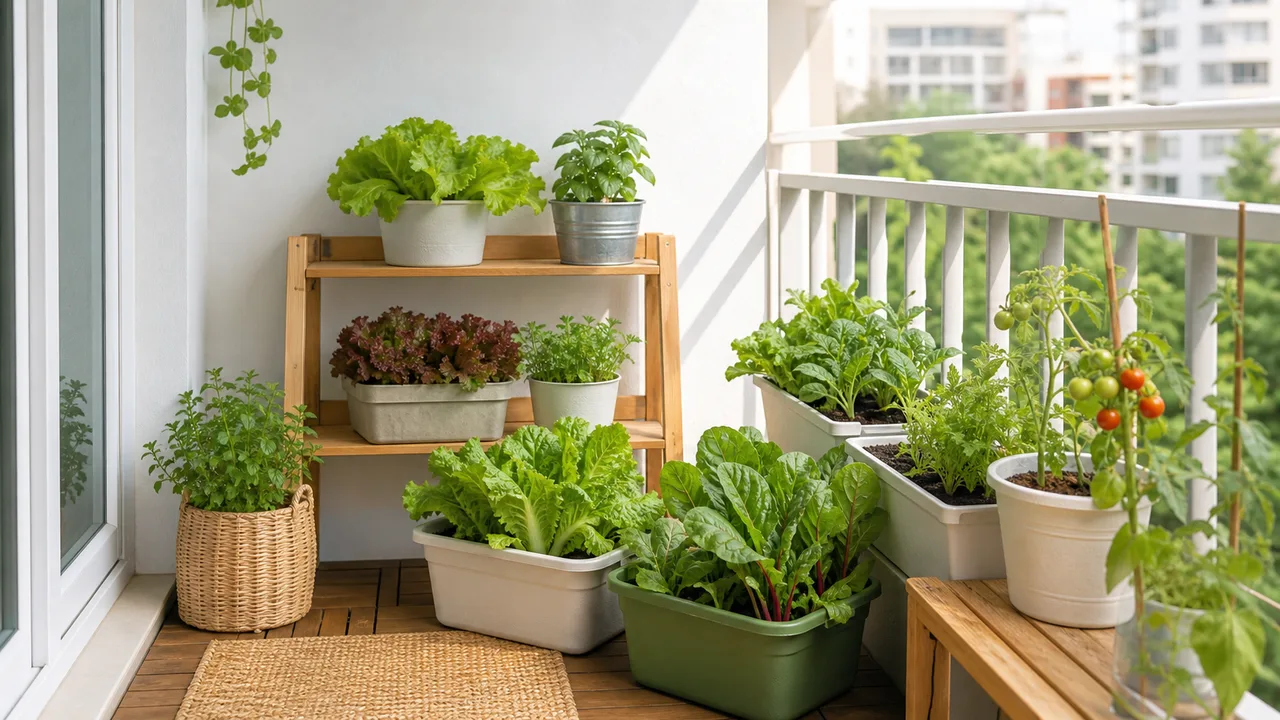
The quickest useful balcony harvest usually comes from growing leaves, not full heads. Start by deciding whether you want baby leaves for frequent small cuts or mature plants for larger individual leaves. That choice determines the container, spacing, crop mix, and replanting rhythm.
Choose the harvest format first
Baby-leaf production uses closer spacing and harvests young leaves together. It works well when the goal is a regular bowl of mixed greens from a shallow, wide container.
Mature-leaf production gives each plant more room. Use it for full-size lettuce, chard, or kale that will be picked leaf by leaf. Mature plants need more root volume and remain in the container longer.
Do not try to produce both systems at full density in one small box. A useful compromise is to divide a rectangular planter into sections: two sections for staggered baby leaves and one for a few mature plants.
Match the crop to flavor and temperature
For mild salads, start with loose-leaf lettuce. For stronger flavor, add arugula or mustard greens. Mizuna and komatsuna offer tender leaves with more texture; spinach favors cool conditions; Swiss chard handles warmth better but grows more slowly and needs more space as it matures.
University of Maryland Extension lists lettuce, endive, arugula, kale, mustard, broccoli raab, mizuna, komatsuna, spinach, chard, leafy amaranth, parsley, cilantro, and basil among crops used in salad boxes and tables. That does not mean they mature at the same speed or prefer the same weather.
Treat seed-packet timing as the local starting point. Maryland Extension gives useful production ranges for salad greens—about 12–24 days for microgreen size, 25–40 days for baby leaves, and 40–60 days for mature greens—but states that crop, spacing, season, and weather change those times. Use the ranges to plan observations, not to promise a harvest date.
Build one reliable container system
Choose a wide container with drainage holes and enough depth for the intended harvest. Maryland’s Salad Box design is about 3.5 inches deep and is specifically built for shallow-rooted baby greens. For plants grown beyond the baby-leaf stage, choose a container with greater depth and root volume according to the crop-specific guidance on the seed packet or from a local horticultural authority. Give mature chard or kale wider spacing than a densely sown baby-leaf mix.
Fill with fresh container growing mix rather than garden soil. Moisten the mix before sowing so dry material does not float and move the seed. Place the container where cool-season greens receive useful direct light but can be moved away from punishing afternoon heat.
Put a tray beneath the container only if runoff must be captured, and empty excess water. Drainage is still necessary; saturated mix excludes air from roots.
Sow in sections instead of all at once
Divide the surface into three or four dated sections. Sow the first section now, the next after roughly two weeks, and continue while conditions suit the crop. University of Maryland Extension describes this as succession planting: several small groups are planted over time instead of one large group maturing together.
Follow the seed packet for depth. For a baby-leaf mix, distribute seed evenly enough that emerging plants have air between them; for mature plants, thin to the packet’s final spacing. The Maryland Salad Box method uses rows about four inches apart with seed initially one to two inches apart, but that layout belongs to its specific system. Adjust for the crop and the final leaf size you want.
Label each section with crop and sowing date. The label turns vague impressions into useful decisions: which mix emerged fastest, which became bitter, and which spacing produced clean leaves.
Manage moisture without a fixed calendar
Young greens have a small root zone and lose quality when they repeatedly wilt. Check below the surface with a finger. Water when the mix is beginning to dry, then wet the full root zone and allow excess water to drain.
Container size, wind, sun, plant density, and temperature determine frequency. A small box in a hot breeze may need attention daily; the same box in cool weather may not. Avoid light surface sprinkles that leave deeper roots dry, and avoid automatic watering when the mix is already wet.
Crowding and wet leaves can encourage problems. Thin weak seedlings, remove decaying leaves, and water the mix rather than repeatedly soaking foliage late in the day.
Use heat as a crop-change signal
Lettuce and spinach commonly struggle as conditions become hot: growth may race toward flowering, and leaves can become bitter. Moving a portable container out of harsh afternoon sun may extend quality, but shade cannot turn an unsuitable hot period into cool weather.
When repeated sowings bolt quickly, switch strategy. Pause lettuce, try more heat-tolerant chard or leafy amaranth, or leave the container ready for a cooler planting window. A balcony guide for a global audience cannot assign universal months; use local temperature patterns and regional planting guidance.
Harvest in a way that supports the next cut
For baby greens, cut clean leaves above the growing point rather than scraping the mix. Maryland Extension’s Salad Box guidance suggests cutting about one inch above the mix; leaves may regrow for a later cut, often around 25–30 days in that system. Regrowth is conditional, not guaranteed.
For mature loose-leaf plants, remove outer leaves and leave the center intact. Stop expecting another cut when growth becomes weak, tough, bitter, diseased, or heavily damaged. Pull the spent plants, refresh fertility according to the growing-mix or fertilizer label, and sow the next section.
The production loop is simple:
- sow one dated section;
- observe emergence and thin;
- maintain even moisture;
- harvest at the chosen leaf size;
- judge regrowth;
- replace the section when quality falls.
That loop—not a single “fastest vegetable” ranking—is what keeps a small balcony producing useful greens.
Sources
- University of Maryland Extension, “Salad Greens to Grow in Salad Tables or Salad Boxes”: https://extension.umd.edu/resource/salad-greens-grow-salad-tablestm-or-salad-boxestm
- University of Maryland Extension, “Plant, Fertilize, Water a Salad Table or Salad Box”: https://extension.umd.edu/resource/plant-fertilize-water-salad-tabletm-or-salad-boxtm
- University of Maryland Extension, “Growing Vegetables in Containers and Salad Tables”: https://extension.umd.edu/resource/growing-vegetables-containers-and-salad-tables
- University of Maryland Extension, “Vegetable Succession and Companion Planting”: https://extension.umd.edu/resource/vegetable-succession-and-companion-planting
This guide provides general educational information. Conditions, regulations, structures and plant requirements vary; verify decisions against your own site and relevant local guidance.