Simple Home Soil and Fertilizer Mix for Balcony Vegetables
The safest simple starting point for balcony vegetables is a fresh commercial soilless potting mix labeled for containers, followed by fertilizer according to that product and crop label. If you want to blend at home, use a bounded recipe b
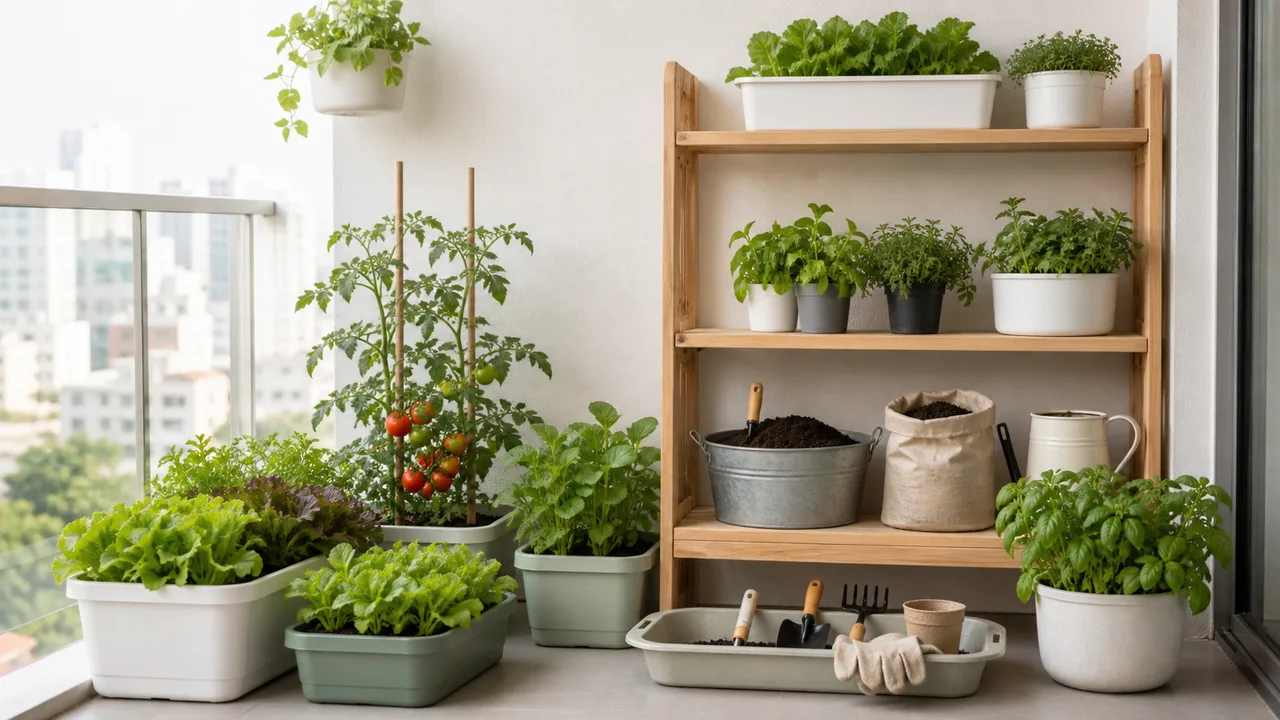
The safest simple starting point for balcony vegetables is a fresh commercial soilless potting mix labeled for containers, followed by fertilizer according to that product and crop label. If you want to blend at home, use a bounded recipe built from known container-media ingredients—not garden soil plus an improvised amount of fertilizer.
There is no single ratio that suits every ingredient, crop and climate. Peat, coir, compost, bark, perlite and vermiculite differ in water retention, aeration, pH and nutrient contribution. The practical goal is a medium that anchors roots while holding both water and air.
Choose between two safe routes
Route A: use a packaged container mix
Select a lightweight product labeled as potting or container mix. Read whether it already contains fertilizer, compost, lime or a wetting agent. Do not add a full second fertilizer charge without accounting for what is already present.
University of Maryland Extension advises avoiding media that feel heavy or gritty, are very dusty or clumped, or use easily compacted sedge peat.
Route B: make a small trial blend
University of Arizona Cooperative Extension publishes a container-media recipe made from equal parts finished compost, coarse builder's sand and peat moss. Use those three ingredients in equal volumes. It is one documented recipe for the Southwest desert, not a universal ideal; local conditions and ingredient texture still affect how a mix holds and releases water.
Use clean ingredients intended for horticultural use. Avoid substituting raw manure, unfinished compost or soil from an unknown site. If topsoil is used at all, UMD limits it to very large containers and no more than 10% of the mix volume; for an ordinary balcony pot, leaving it out is simpler.
Measure by volume
Choose one scoop and use it for every part. For a 9-liter trial batch using the University of Arizona equal-parts recipe, combine:
- 3 liters mature compost;
- 3 liters coarse builder's sand;
- 3 liters peat moss.
Wear appropriate protection listed on product labels and avoid breathing dust. Moisten dry peat-based material gradually before filling pots; UMD describes the target as evenly damp, comparable to a wrung-out sponge. Mix in a ventilated area and keep materials from blowing off the balcony.
Do not add a “drainage layer” of gravel to compensate for a poor medium. Use a container with functioning drainage holes and a medium designed to retain air after watering.
Treat fertilizer as a separate decision
Compost and fertilizer are not interchangeable, and more is not automatically better. First identify what the mix already contains.
UMD advises that when a growing mix contains 50% compost, reduce the fertilizer amount by half and wait until plants are growing before applying it. For other blends or packaged products, follow their labels rather than extrapolating that rule.
Use this sequence:
- Read the potting-mix label for starter fertilizer and duration.
- Read the fertilizer label for edible crops, container use, dilution and frequency.
- Match the amount to the actual container volume—not an estimated balcony area.
- Measure with a dedicated tool and never exceed the label rate.
- Record the date and product so a second person does not feed the same pot again.
Do not publish or follow a spoon-per-pot formula without naming the product concentration. Fertilizers with different analyses and formulations cannot safely share one volume dose.
Fill, water and test one container
Cover large drainage openings only with a screen or method permitted by the container instructions; do not seal them. Fill without compressing the medium into a dense block. Water slowly until the mix is evenly moist and excess can leave the pot.
Trial the blend in one container before preparing the whole balcony. During the first irrigations, watch whether water penetrates the mix, whether drainage remains open, and how quickly the root zone changes from moist to dry under the balcony’s actual weather.
If water races down a gap at the pot edge while the center stays dry, re-wet the medium gradually. If the mix remains saturated and airless, stop adding water and reassess the container openings and ingredients. Persistent plant symptoms need diagnosis; do not automatically add fertilizer.
Adjust only one component at a time
For the next batch—not the planted pot—make one documented change:
- If the mix dries too rapidly or stays saturated despite open drainage, do not improvise a new ratio in a planted pot. Record the behavior and consult a locally appropriate container-media recommendation before the next batch.
- If the product or compost has unknown pH or soluble-salt characteristics, do not guess at lime or fertilizer additions; use a tested product or seek a local media test.
Do not reuse medium from a container that had a root-disease problem. Reused soilless media also breaks down over time, reducing pore space, so its physical behavior must be reassessed rather than assumed.
Safety boundaries
- Follow every ingredient and fertilizer label, especially edible-crop restrictions, protective equipment, storage and disposal.
- Confirm balcony drainage, weight and building rules locally; this guide does not calculate structural capacity.
- Use local Extension or a qualified laboratory when precise pH, nutrient or soluble-salt decisions are needed.
The simplest dependable system is deliberately modest: known container media, one documented blend, label-based fertilizer and a one-pot trial before scaling.
Sources
This guide provides general educational information. Conditions, regulations, structures and plant requirements vary; verify decisions against your own site and relevant local guidance.